

By Blake Napierala
The Quick Answer
Terpenes are aromatic compounds found in cannabis and many other plants. They help shape aroma. A terpene profile shows which terpenes were measured and how much was found; it does not, by itself, tell you THC strength or guarantee how a product will feel.
What Do Terpenes Do?
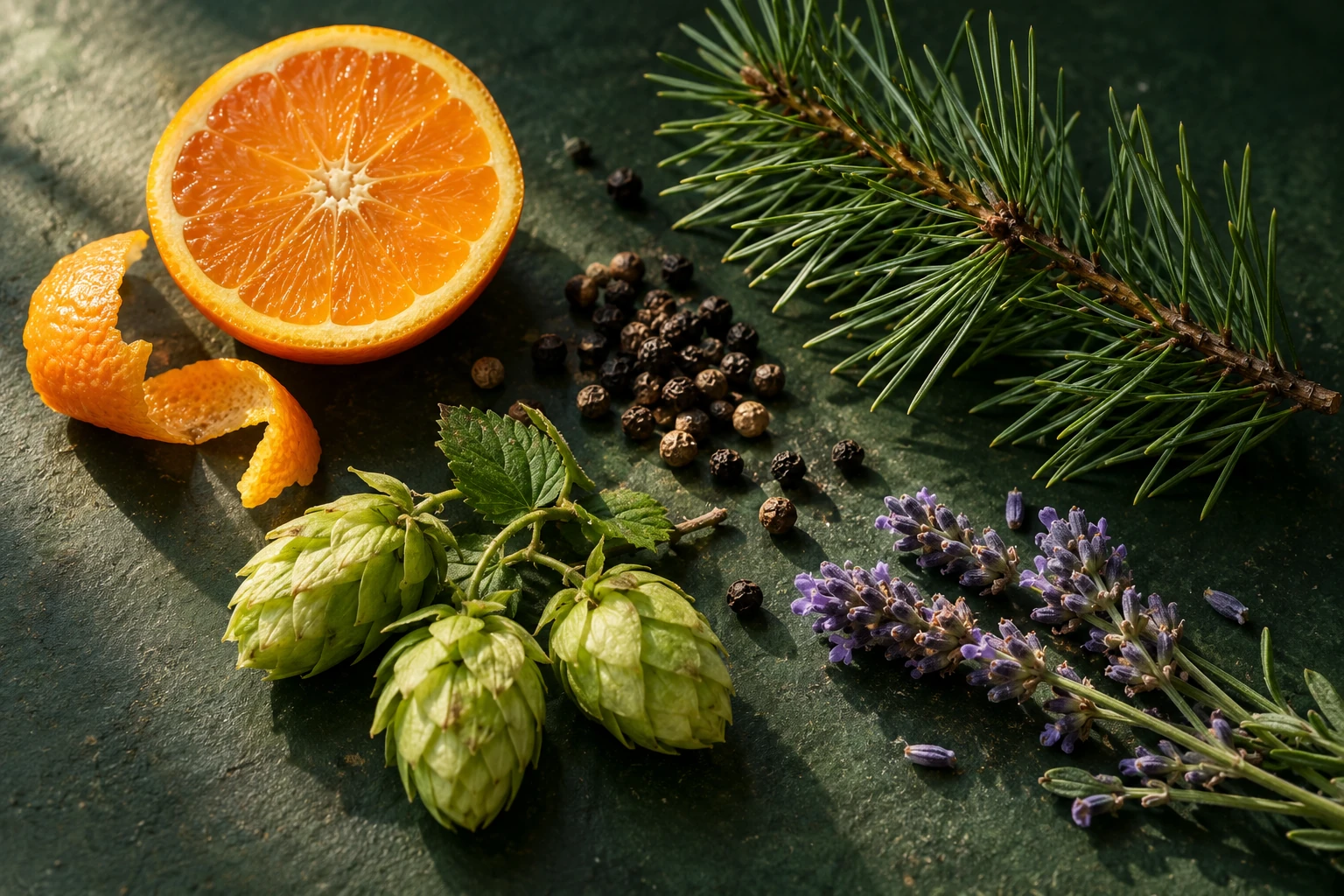
Terpenes contribute to familiar scents, including citrus and pine. Cannabis contains a mixture of these compounds, rather than one terpene acting alone. That is why a single name rarely describes the whole aroma.
Other compounds matter, too. In a study of cannabis extracts, researchers found that compounds outside the terpene family helped explain major aroma differences, even when the terpene profiles looked similar. A profile is useful information, but it cannot capture everything your nose detects. Read the cannabis aroma study.
Five Common Terpenes to Recognize
You do not need to memorize every terpene. These five are a useful starting point when reading profiles:
| Terpene | Common aroma descriptions |
|---|---|
| Limonene | Citrus, particularly orange-like notes |
| Beta-caryophyllene | Spicy or peppery |
| Alpha-pinene | Pine-like and resinous |
| Linalool | Floral, with sweet or citrus notes |
| Myrcene | Sweet and balsam-like, a resinous scent |
The citrus and pepper descriptions appear in the cannabis aroma research. The other descriptions are supported by the alpha-pinene and myrcene chemical records and a study of linalool’s odor.
Think of these as scent references. A product containing limonene will not necessarily smell only like citrus, and a floral note does not establish a particular effect. The mixture and the amounts matter.
How to Read a Terpene Profile
Look for named terpenes and their percentages on the package or its Certificate of Analysis, often shortened to CoA. This is the product’s lab report. New York’s consumer guidance says regulated products provide a QR code or link to that report. See the state’s consumer information.
New York requires a terpene profile when the outermost package mentions a specific terpene, or when terpenes have been added to an oil for vaporization. The required profile includes the three most concentrated terpenes and their approximate percentages. It may be on the outer package or in the lab report when the package clearly explains how to find it. Read New York’s terpene profile guidance.
Check What the Percentage Is Measuring
A percentage can describe a terpene’s share of the whole product or its share of the total terpene content. New York’s guidance allows both approaches, so two large-looking numbers may be measuring different things.
Here is a made-up example using percentages by weight:
| Measurement | Example result |
|---|---|
| Total terpenes in the product | 2% |
| Limonene in the product | 0.6% |
| Limonene’s share of those terpenes | 30% |
The last two rows describe the same limonene amount: 0.6 divided by 2 equals 30%. They do not mean the product contains 30% limonene. Before comparing profiles, check that the percentages use the same basis.
Can Terpenes Tell You How Cannabis Will Feel?
Not reliably on their own. Researchers are studying how terpenes interact with THC, but that does not establish a dependable mood chart for every product.
For example, a small controlled human study found that vaporized limonene reduced some THC-related anxiety ratings under the conditions tested. Most other measured THC effects were unchanged. That finding does not prove that every limonene-containing product will feel calming. Read the controlled limonene study.
Keep the terpene information separate from THC strength. Product form, cannabinoid content, the amount consumed, and individual response also matter. Our THC percentage and milligrams guide explains those two potency measurements.
A Simple Profile Checklist
When you read a profile, ask:
- Which terpenes are listed?
- Are the numbers percentages of the product or percentages of its terpenes?
- Is there a total terpene result?
- Does the lab report match the product and batch on the package?
- What does the rest of the label say about THC, ingredients, and product form?
Keep notes about aromas you notice. Those observations can be more useful than trying to turn one terpene name into a prediction.
Frequently Asked Questions
Does a higher terpene percentage mean better cannabis?
A higher number tells you that more was measured on that reporting basis. It does not, by itself, establish better quality or a more suitable product. Compare the whole label and avoid treating the percentage as a rating.
Is a terpene profile the same as a strain name?
No. A strain name identifies a named variety. A terpene profile reports measured compounds. Use the actual product’s information rather than assuming its name tells you the percentages.
Does every product list all its terpenes on the package?
No. A required New York profile generally begins with the top three, and the information may be provided through an accessible lab report. Vape oils with added terpenes have additional disclosure requirements.
Explore Our Cannabis Guides
Keep learning with our guides to cannabis labels, THC measurements, and infused versus non-infused pre-rolls.
Visit The Phinest Buds
The Phinest Buds is at 576 Dick Road, Suite 10A, Depew, NY 14043. Have a question about reading a cannabis label or finding its lab report? Contact our team or see our location information before visiting.
